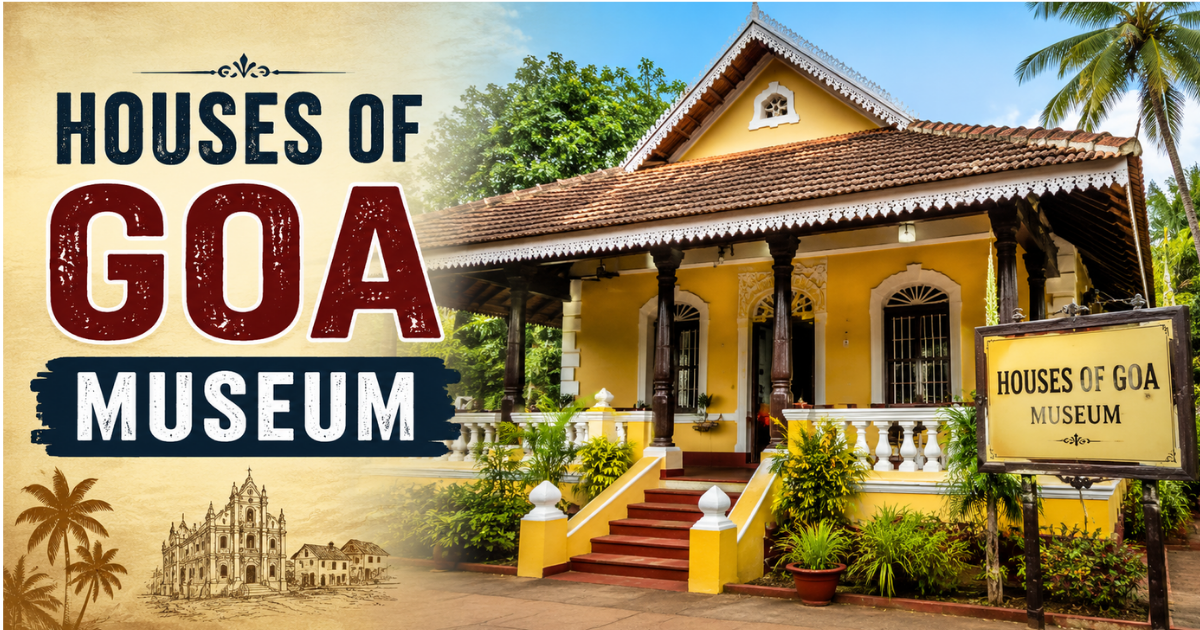
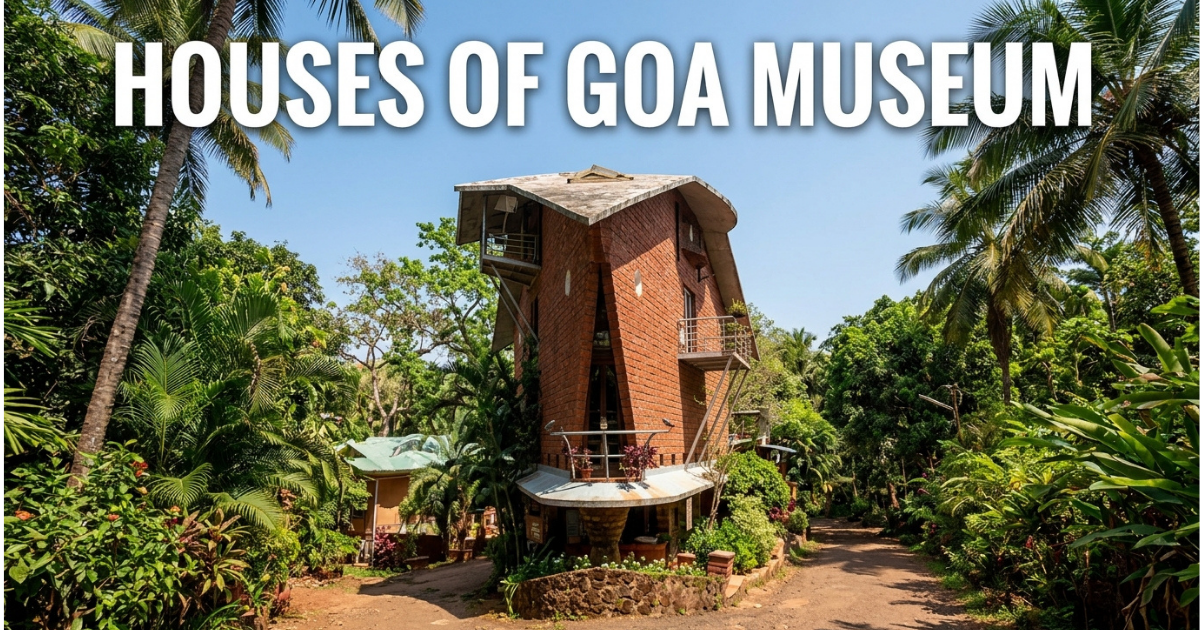
I still remember the first time I drove through Goa Bardes and spotted a strange triangle-shaped building rising like a ship near the road. That moment gave me my introduction to the Houses of Goa Museum, tucked away in Torda, close to Franka, a short ride from Panaji in North Goa.
A friend had shared the exact location pin, only 7 km from the city, and I understood why locals call this spot a traffic island with real personality. Gerard de Cunha, a renowned architect, built this little gem in 1997, rising across three stories connected by a spiral staircase that works as the central piece, connecting displays on every floor.
What struck me is how this distinctive museum avoids the feel of conventional museums; instead of static historical objects, the Houses of Goa Museum breathes real cultural identity and encourages cultural interaction.
Goa carries a reputation for its beaches, churches and temples, but the Houses of Goa Museum tells a different story about the state’s vibrant culture and architectural heritage, shaped across centuries.
Inside, photographs, illustrations, paintings and other traditional objects trace the evolution of houses and local architectural traditions, formed where Portuguese influences met local traditions. I left with a much sharper sense of how Goan homes and old Goan houses reflect the region’s history and architecture.
What Is the Houses of Goa Museum
This specialized museum focuses entirely on Goan domestic architecture, skipping the habit of stacking historical artifacts behind ropes. Architect Gerard de Cunha designed the ship-shaped building so the structure itself teaches visitors about construction and the materials once used in old Goan homes.
Walking through, you notice architectural components, drawings, photographs and household objects showing how homes evolved, giving the whole museum experience a hands-on, personal quality.
Museum Architecture the Ship-Shaped Structure
Standing outside in Goa Bardes, I studied the triangular structure for several minutes, because the ship-like appearance is genuinely hard to ignore. Gerard de Cunha shaped the whole building like a triangle resembling a ship, balanced on three pillars, with a central cylindrical pillar marking the main entrance.
Inside, the winding staircase, also the spiral staircase, links three stories and forms the central piece of this architectural marvel, completed in 1997.
The geometrical structure blends Portuguese and Goan styles, with genuine home decor items from a bygone era across the three levels, reflecting true Goan architecture shaped by local Indian traditions meeting Portuguese influences.
The building elements, including furniture, paintings and decorative objects, bring the story to life, echoing the triangular form through practical displays rather than decoration alone. The triangular structure also performs real work: it helps reduce heat and limit heat indoors, while balconies pull in natural light and support steady ventilation.
The building’s careful orientation shows thoughtful sustainable design, and students researching architectural experimentation often visit specifically to see how functional and artistic goals meet in one place.
First Floor
On the first floor, sketches by Mario Miranda walk visitors through Goa’s history, starting from 1300 BC, showing how Portuguese influence and Portuguese rule reshaped the region’s architecture.
These illustrations turn a historical presentation into something genuinely engaging, far from a dry timeline of colonial-era houses, and I lingered over sketches capturing Goan identity in small, human details.
This level also displays quirky treasures like wooden coat hangers, wooden hands used as picture frames, tiny roosters perched on model roofs, and the machila, a hand-ported carriage built for two people, once common outside Goan hotels — all paired with photographs and short descriptions.
The first floor further highlights eight notable Goan houses that reveal true variety within residential architecture: Solar Loyola Furtado (Chinchinim), Casa Dos Mirandas (Loutulim).
The Rane House (Sanquelim), Casa Do Godinho Jacques (Majorda), Casa Dos Hospedes (Deshprabhu, Pernem), The Naik House and Palacio Santana Da Silva (both Margao), and The Figueredo House (Loutulim) — each carrying its own chapter of Goa’s story.
Second Floor
Climb to the second floor and you’ll find railings, doorways and door frames rescued from old homes across Goa, sitting beside salvaged architectural elements, paintings, ornaments and other decorative features taken from real Goan homes. Studying each piece, I noticed the craftsmanship and decorative details that once shaped everyday Goan homes, alongside further architectural components.
Third Floor
The top floor opens into an open auditorium filled with Portuguese balcaos, quiet hallways, sturdy wooden furniture and old paintings, alongside sacred Tulsi Vrindavans honouring the tulsi plant. Nearby, Hindu symbols sit comfortably next to crosses representing Christian influences, a mix that says a lot about Goa’s cultural diversity.
And from this elevated position, you get a lovely view of the natural setting and surrounding landscape around Torda. A small cafeteria here sells bottled water and packet snacks, and it occasionally runs architectural workshops on this floor, giving guests a hands-on feel for traditional craft.
Mario Miranda’s Contribution
Before leaving, I stopped at the souvenir shop to browse genuine Mario Miranda art, sold inside a Goan Portuguese mansion that functions as a heritage building, its classic architecture and antique furniture carrying real old-world charm.

The Houses of Goa Museum curates a permanent collection of his cartoons and sketches, tracing the evolution of style and diversity of subjects across his career from everyday Goan culture and colonial architecture to lively street scenes full of humour.
The gallery also runs special exhibitions and themed exhibitions, sometimes built around collaborations with other artists, keeping the space feeling fresh even for repeat visitors.
Fans of merchandise will find prints, calendars, t-shirts, mugs, coasters and books, all supporting the preservation and promotion of his legacy, while guided tours led by knowledgeable guides offer real insights into his inspiration.
A small library and reading room stock related publications, perfect for quiet reflection. Beyond that, this space works as a genuine cultural hub for the local community, with regular art workshops, film screenings, book launches and talks, and through strong visual storytelling, the Miranda Art Gallery displays both original cartoons and recreated cartoons, along with related products and illustrations.
Traditional Goan House Features
A traditional balcao, the covered sitting area near the front door, reveals the social character of old Goan homes, where neighbours once stopped to chat, while a nearby Tulsi Vrindavan, built for worship and cultivation of the sacred plant, ties to Hindu cultural traditions. Inside, wooden furniture reflects genuine craftsmanship and practical design, passed down through generations.
Decorative elements like railings, columns, paintings and patterned flooring sit alongside small ornamental objects, plus playful pieces such as wooden coat hangers, decorative wooden hands, picture frames and rooftop rooster figures among the liveliest household objects on display.
Together, they represent both religious traditions and everyday cultural traditions. What struck me most was seeing Christian symbols like crosses placed near Hindu elements at the entrance of each recreated home, without a hint of tension, a gentle reminder of how naturally these traditions blended inside Goan households.
The Machila
The machila stands out as one of the strangest objects in the Houses of Goa Museum: a manually carried hand-ported carriage that seats two people sitting opposite each other, once used as transportation tied to old hospitality practices at Goan hotels during an earlier period. Seeing it up close taught me more about social practices than any textbook could.
Location and Visiting Information
You’ll find the Houses of Goa Museum at House No. 674, close to Nisha’s Play School in Torda, under Salvador do Mundo, Penha de França, Goa, pin code 403101, running as a privately administered institution on the Museums of India listing since 1997.
From Panaji, it sits roughly 7 km away, or about 8 km from the Panaji bus stand, under the Salvador do Mundo panchayat near Porvorim, reachable by car or two-wheeler in about half an hour, depending on local traffic.
It welcomes visitors Tuesday to Sunday, 10:00 AM to 7:30 PM, closed on public holidays, and most people spend one to two hours exploring the floors. Entry costs around ₹150 as the museum entry fee, plus a separate Hanging Bridge entry fee of ₹50 — since ticket prices can change, check current rates before you set out.
Why Visit Houses of Goa Museum
If you care about architecture, history or culture, the Houses of Goa Museum genuinely rewards a visit, bringing together real building components, artwork, decorative objects and historical objects instead of hiding everything behind glass.
You walk away understanding how cultural influences shaped both the people and their traditional homes. The building’s ship-like form and climate-responsive design show off real architectural creativity, which explains why many travelers stop here, and compared with typical traditional Indian homes, the museum exhibits and overall architectural design feel fresh, with household objects, furniture and Mario Miranda’s illustrations scattered through the galleries.
Conclusion
By the end of my visit, the Portuguese-inspired balcaos, old wooden furniture and quiet Tulsi Vrindavans stayed with me most, alongside small architectural details and Mario Miranda’s artwork scattered everywhere.
The Houses of Goa Museum pulls together diverse influences to explain Goan domestic architecture in a way no beach or nightclub ever could — Goa carries a reputation for its beaches and nightlife, but this place tells a quieter, deeper story.
Design traditions behind distinctive homes, real laterite houses and tiled roofs show how Portuguese influences and Hindu elements shaped everyday life, and every room adds another layer through decorative features connected to Goan domestic heritage.
I left carrying a memorable glimpse into Goa’s true architectural identity, grateful that Gerard de Cunha chose to preserve this slice of history. Anyone visiting the Houses of Goa Museum once tends to return for a second look.
FAQs
Where is the Houses of Goa Museum located?
It sits in Torda, near Porvorim in North Goa, roughly 7–8 km from Panaji.
Who designed the Houses of Goa Museum?
Architect Gerard de Cunha conceptualised and built it in 1997, giving it a triangular, ship-like form.
What are the Houses of Goa Museum’s timings and entry fee?
The museum opens Tuesday to Sunday, 10:00 AM to 7:30 PM, with an entry fee of around ₹150 and a separate ₹50 charge for the Hanging Bridge.
What can visitors see inside the Houses of Goa Museum?
Visitors explore three floors featuring Mario Miranda’s sketches, salvaged architectural elements, traditional furniture, balcaos, Tulsi Vrindavans, and unusual objects like the machila.
How long does a visit to the Houses of Goa Museum take?
Most visitors spend one to two hours exploring it at a relaxed pace, including the souvenir shop and nearby Miranda Art Gallery.
