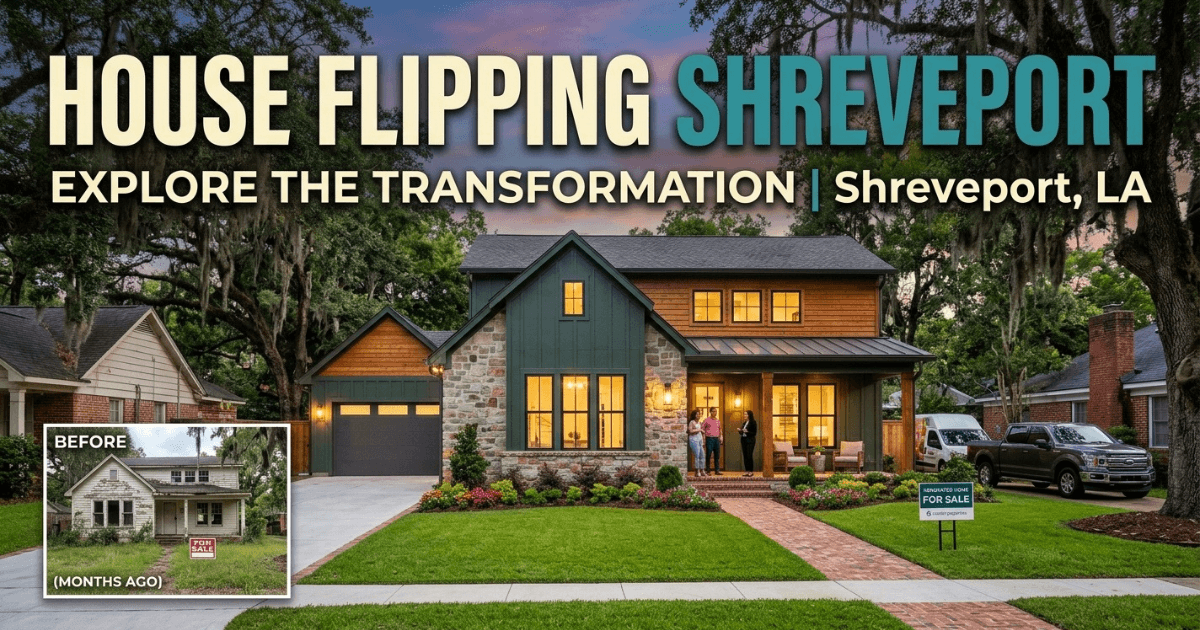
House flipping Shreveport deals keep landing near the top of national profit rankings, even as returns shrink across most of the country. The city pairs a low entry price with steady buyer demand, and that mix still works for patient investors. This guide walks through the latest numbers, the costs, the financing, and the practical steps that separate a good flip from a painful one.
Most figures below are ATTOM data, from a national property firm that publishes a quarterly home flipping report. ATTOM measures gross profit as the difference between the buy price and sale price, before renovation and other costs. Keep that in mind, because your real take-home profit will always be lower than the headline number.
What is happening with house flipping in Shreveport right now?
Shreveport is one of the most profitable flipping metros in the United States. In ATTOM’s Q1 2026 report, the Shreveport metro ranked third nationally for profit margin, with a typical return on investment (ROI) of 104.1%. Investors bought at a median of $89,165 and resold at a median of $181,950.
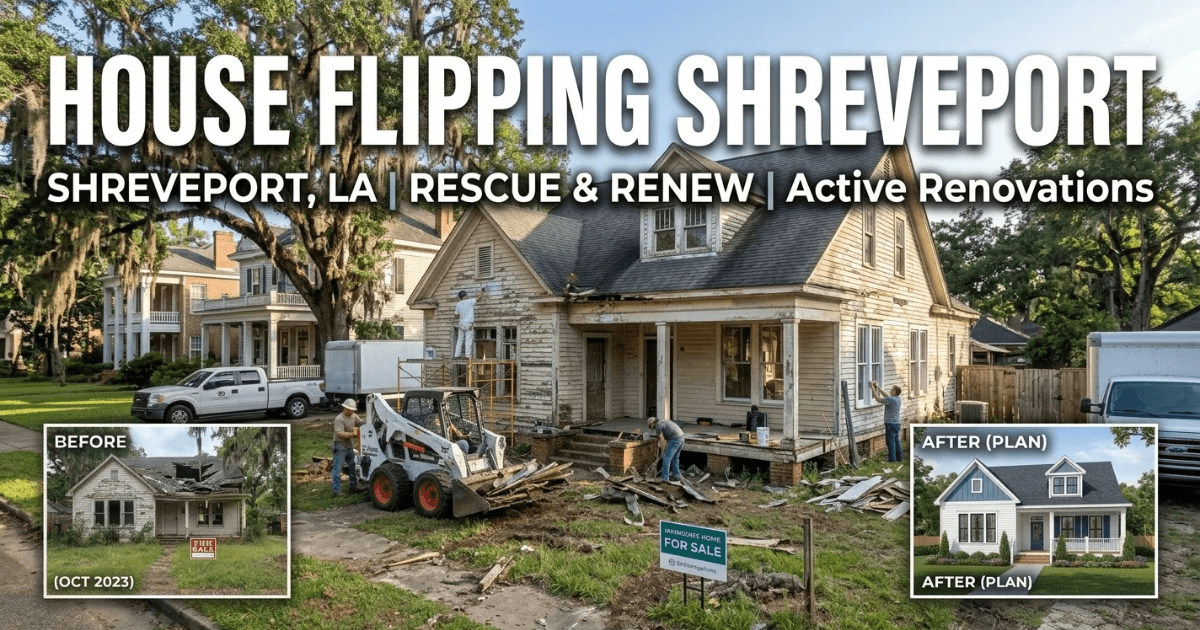
That ranking covered metros with more than 200,000 people and at least 50 flips in the quarter. In ATTOM’s Q3 2025 report, Shreveport posted an 86.5% typical margin, which placed it fifth in the country.
For anyone weighing house flipping Shreveport opportunities, the typical flip roughly doubled its purchase price in early 2026. The gross gain on those median figures works out to about $92,785. That money still has to cover repairs, loan costs, taxes, and selling fees, so treat it as a starting point rather than profit.
How does Shreveport compare with the rest of the country?
Shreveport’s returns are several times higher than the national average. ATTOM’s Q2 2026 report put the typical national flipping margin at 21.5%, down from 25.7% quarter-over-quarter and 27.6% year-over-year. Shreveport’s recent results sit far above that level, which makes the city a clear outlier among U.S. markets.
Nationally, investors flipped 77,991 single-family homes and condominiums in Q2 2026, which equaled 6.2% of all home sales. The typical median gross profit was $60,526, and the average time to flip was 161 days. ATTOM also notes that it expanded its record coverage in 2026, so deal counts may not line up perfectly with older reports.
The contrast with nearby Texas is striking. In Q2 2026, large Texas metros posted single-digit returns, with Dallas at 1.8%, Austin at 2.8%, and Houston at 3.7%, while San Antonio flips posted a 0.3% loss on investment. Louisiana did better, with New Orleans posting a 75% typical margin among metros over 1 million people.
Why are flipping profits falling nationwide?
Rising home prices are the main reason. When properties cost more to buy, the gap between purchase price and resale price narrows, so shrinking margins follow. ATTOM’s CEO said in late 2025 that the market had shifted from the 40% to 60% returns seen for more than a decade after 2009.
Typical national returns fell below 25% in Q3 2025, the lowest level since 2008. Since then, results have moved within a narrow band in the low-to-mid 20% range. That trend pushes investors toward cheaper metros where the spread between “as is” and “fixed up” is still wide.
This is exactly where Shreveport fits. Lower purchase prices leave more room for value-add work, which keeps the flipping market there more forgiving than in pricier cities.
Why does Shreveport produce such high flipping returns?
Shreveport combines cheap housing, older homes that need work, and a mixed local economy. Investors can buy dated properties at low prices, update them, and sell to a steady pool of buyers. That spread between distressed properties and their renovated resale value drives the high percentage returns you see in national reports.
High percentage returns also come partly from math. A $90,000 purchase that gains $90,000 shows a 100% return, while a $400,000 purchase with the same gain shows only 22.5%. Lower prices make each dollar of improvement look larger in percentage terms.
What role does the low median home price play?
Shreveport’s low prices give flippers a cheap entry point. Local brokerage Osborn Hays Real Estate reported a median home price of about $144,800 in early 2025, well below state and national averages. Flip purchases often run even lower, since investors target homes that need repairs.
Low prices also reduce risk in one key way: you need less cash to get started. However, Osborn Hays also reported modest appreciation rates of about 0.38% per year over the past decade. That means you cannot count on the market lifting your value; your renovation has to create the profit.
Data also shows there is a floor to aim above. Nationally, ATTOM found that homes bought for $50,000 or less produced a typical loss of $15,000 in Q2 2026. Homes bought between $100,000 and $200,000 earned the strongest typical margin, at 28%.
Which local industries keep buyer demand steady?
Healthcare, the military, gaming, and film all support Shreveport’s housing demand and keep buyers coming. Major employers include Willis-Knighton Health System and Ochsner LSU Health Shreveport. Barksdale Air Force Base in nearby Bossier City also brings a steady flow of new households who need homes.
This diverse economy gives the area more stability than a town tied to one industry. Military personnel move in on regular rotations, and the healthcare sector draws doctors, nurses, and students. Casinos and film production add jobs too, supported by Louisiana film tax incentives.
For flippers, this matters because buyers need jobs and reasons to stay. Watch for new infrastructure developments and revitalization projects, especially in downtown Shreveport. Osborn Hays notes that roadway expansions and downtown projects are lifting property values in some areas.
Who buys flipped homes in Shreveport?
In Q3 2025, Shreveport had the highest share of flipped homes sold to FHA buyers in the nation, at 27.6%. In Q1 2026, the share was 24.4%, still fourth highest in the country.
These buyers use Federal Housing Administration-backed mortgages, which allow a smaller down payment than many conventional loans. Nationally, only about 10.7% of flipped homes went to FHA buyers in Q2 2026. Shreveport’s share runs more than twice that rate.
Military households, healthcare workers, and local families round out the buyer pool, and most want move-in-ready homes at affordable prices.
Why do FHA buyers matter so much for flippers?
FHA buyers shape how you renovate and price your flip. FHA loans require an appraisal and minimum property standards, so the home must be safe, sound, and fully working. If your renovation cuts corners, the deal can stall during underwriting.
Plan your scope so the home passes inspection the first time. That usually means a sound roof, working systems, no peeling paint in older homes, and safe electrical work. Ask your agent what local FHA appraisers commonly flag before you finalize your rehab budget.
What’s the Real Cost of Flipping a House in Shreveport?
You need enough for the purchase, the renovation, holding costs, and selling costs. Using ATTOM’s Q1 2026 Shreveport medians, a typical deal bought around $89,000 and sold near $182,000. Your total budget depends on the home’s condition, your loan terms, and how fast you finish.
Here is a rough, estimated breakdown based on those medians. ATTOM notes that experienced flippers estimate rehab and related costs at 20% to 33% of the after-repair value (ARV). On a $181,950 sale, that comes to roughly $36,390 to $60,044.
Subtract that from the $92,785 gross gain and you land at roughly $32,700 to $56,400, before loan interest, insurance, taxes, and agent fees. These are estimates only. Your own numbers could be higher or lower.
How much should you budget for renovation costs?
Most investors build their renovation costs budget around the ARV and work backward. A common approach uses the 20% to 33% of ARV range that ATTOM cites from experienced flippers. Then add a contingency buffer, since older Shreveport homes often hide surprises behind the walls.
Start with a contractor walkthrough before you make an offer. Older fixer-uppers, such as Craftsman bungalows and mid-century ranch houses, can need foundation, plumbing, or wiring work that a quick look will miss. Get written bids from local contractors for the big items.
Prioritize kitchens, bathrooms, flooring, paint, and curb appeal, and skip luxury upgrades that local sales do not support.
What financing options do Shreveport flippers use?
Nationally, 62.9% of flipped homes were bought with cash in Q3 2025, according to ATTOM. Investors without that much cash usually turn to short-term fix and flip loans from specialty lenders offering short-term financing.
These loans are often based on loan-to-cost (LTC) and ARV. For example, lender directory Lenderly lists direct lender Accolend at purchase LTC of up to 90%, rehab LTC of up to 100%, and ARV LTV of up to 75% for experienced investors. Its listed terms for first-time investors are lower, at 80% purchase LTC and 70% ARV LTV.
Terms change often, so always confirm current offers directly. Hard money usually carries higher interest rates than a bank loan but offers fast closings, which helps you win deals. If you plan to rent the home instead of selling, DSCR loans qualify you based on the property’s rental income rather than your personal income.
Which Shreveport neighborhoods make sense for flips?
The best flip neighborhoods have cheap entry prices, rising interest, and recent sales that support your resale price. Among Shreveport’s historic neighborhoods, Osborn Hays points to the Highland Historic District and Allendale as more affordable areas with revitalization activity. South Highlands and Broadmoor are established neighborhoods with older homes and strong buyer appeal.
Each type suits different investment strategies. Affordable, up-and-coming neighborhoods offer bigger percentage gains but more risk on resale speed. Established areas cost more to enter but often sell faster and more predictably.
Good house flipping Shreveport results start with street-level research. Pull recent comparable sales, drive the area at different times, and check crime and flood data. A great house on a struggling block can still sit unsold for months.
What local rules and taxes should flippers know?
You need to understand zoning laws, permits, and property taxes before you start. The city also enforces rental laws if you decide to hold instead of sell. Renovations that change structure, wiring, or plumbing usually need permits, and unpermitted work can derail a sale.

Taxes affect your margins too. Check current property tax rates and how the homestead exemption applies, since your buyer may get it but you likely will not as an investor. Louisiana also offers historic restoration tax credits and a Restoration Tax Abatement program for certain redevelopment projects.
If your flip sits in a historic district, ask the city’s permit office before changing windows, siding, or porches. Rules change, so verify everything with official sources.
What are the biggest risks of flipping in Shreveport?
The main risks are underestimating repairs, slow resale, and thin buyer budgets. Because local prices are low, a single surprise like a foundation repair can wipe out a large share of your profit.
Holding time is another risk. The national average flip takes about 161 days, so plan for at least five to six months.
How do you run a smarter flip in Shreveport?
Focus on accurate comps, realistic repair bids, and a clear exit plan. Build a local team, including a real estate agent, contractor, lender, and closing attorney, before you need them.
Here are practical tips that help most first-time flippers:
- Use the ARV first. Base your offer on what similar renovated homes sold for in the last six months, not on asking prices.
- Get bids before you buy. Walk the property with a contractor during your inspection period.
- Plan for FHA standards. Fix safety items fully, since many local buyers use FHA loans.
- Add a contingency. Set aside an extra 10% to 15% of your rehab budget for surprises; this is a common rule of thumb, not a fixed rule.
- Keep finishes neighborhood-appropriate. Over-improving cuts into your margin without raising the price enough.
- Have a backup exit. If the sale stalls, long-term rentals can carry the property, given steady rental demand from military and healthcare workers.
- Track the data. Check ATTOM’s quarterly reports to see whether local market trends are holding.
Treat your first house flipping Shreveport deal as a learning project. A modest, well-run flip teaches more than an ambitious one that goes over budget.
Is house flipping in Shreveport worth it in 2026?
For careful investors, house flipping Shreveport projects still look attractive in 2026. Local returns have stayed far above the national average in recent ATTOM reports. However, the profits depend on buying right, controlling repairs, and selling to a budget-conscious buyer pool.
Nationally, flipping has become harder, and market conditions now favor investors who pick their location carefully. Shreveport’s low prices leave more room for value-add work, so if you buy well below ARV, budget honestly, and finish on time, you can maximize returns better than in most U.S. metros.
FAQs
Is Shreveport a good place to flip houses?
Yes, recent data shows Shreveport ranked third in the U.S. for typical flipping ROI in ATTOM’s Q1 2026 report, at 104.1%. It also ranked fifth in Q3 2025, at 86.5%. These are gross figures, so your actual profit will be lower after repairs and costs.
How much profit does a typical Shreveport flip make?
In Q1 2026, the typical Shreveport flip had a gross gain of about $92,785, based on ATTOM’s median buy and sale prices. After estimated rehab costs of 20% to 33% of ARV, that drops to roughly $32,700 to $56,400 before financing, taxes, and fees. Your results will vary.
Can beginners do house flipping Shreveport projects?
Yes, beginners can flip in Shreveport, but they should start small. Lower prices reduce the cash you need, and some lenders offer fix and flip loans for first-time investors with lower leverage. A strong local team and a conservative budget matter more than experience alone.
Why do so many Shreveport flips sell to FHA buyers?
Shreveport has many first-time and moderate-income buyers who use FHA loans for their low down payments. In Q3 2025, 27.6% of the city’s flipped homes sold to FHA buyers, the highest share nationwide. Flippers should renovate to FHA appraisal standards to avoid delays.
How long does it take to flip a house in Shreveport?
Most flips take around five to six months from purchase to sale. Nationally, ATTOM reported a typical flip time of 161 days in Q2 2026. ATTOM does not publish a Shreveport-only figure in the reports cited here, so plan for the national average plus a buffer.
