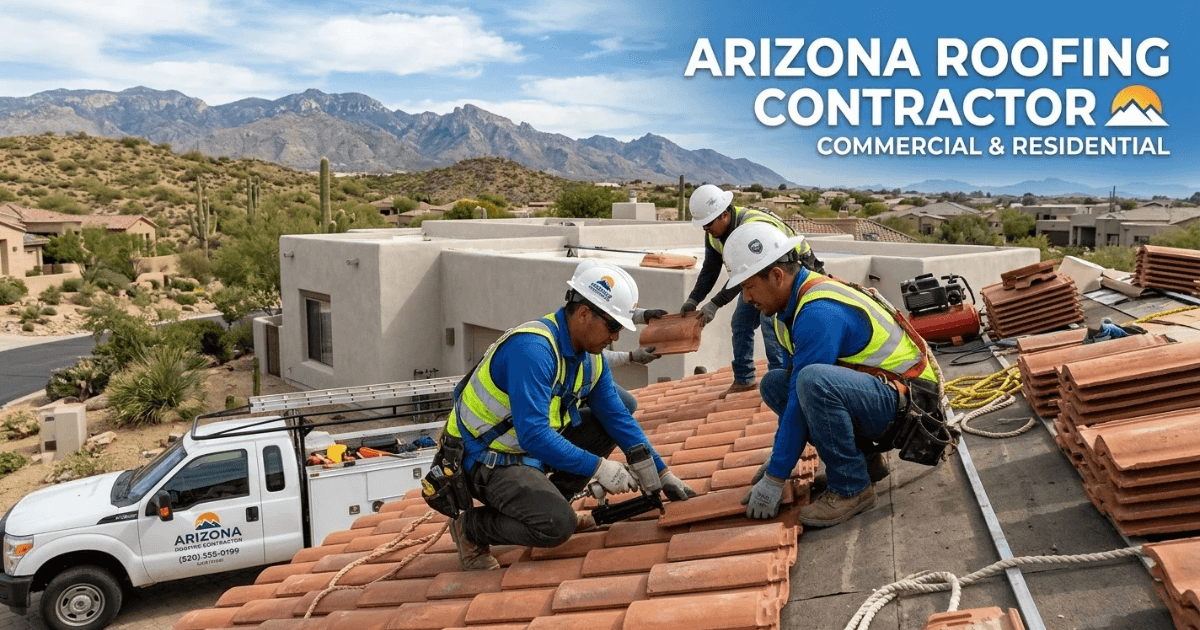
An Arizona roofing contractor designs, installs, repairs, and maintains roof systems that must survive desert heat and summer storms. The work spans residential roofing, commercial roofing, industrial roofing, and multifamily roofing. Strong firms handle everything from one cracked tile on a house to a complete warehouse roof.
A full-service roofing company manages the whole job, from the first visit to the final job site cleanup. A locally owned roofing company often knows city permit rules and HOA habits better than a national chain. Local roofers also send a roofing crew that can reach your home quickly after a storm.
Which services should a full-service roofing company offer?
A capable company should offer roof repair, roof replacement, roof installation, and roof maintenance at a minimum. Many also provide re-roofing, new construction roofing, and roof restoration for aging systems. If a company only sells new roofs, it may steer you toward a replacement you do not need.

Look for a preventative maintenance program, because scheduled checkups catch small problems early. Ask whether the company applies roof coating on flat sections or suggests a recoat instead of tear-off when the surface stays dry. Bigger jobs may call for HVAC unit removal and reset or a full tear-off to the deck.
How do emergency services work during monsoon season?
Arizona’s official monsoon season runs from June 15 to September 30, and storms often arrive with little warning. A prepared contractor offers emergency roof repair, emergency tarping, and storm damage repair during those months. Ask whether the company runs a 24/7 emergency roofing service or answers only during office hours.
Monsoon outflow winds and a sudden microburst can lift shingles and crack tile within minutes. Contractors who list monsoon damage repair, hail damage repair, and wind damage repair know these patterns well. In our review, the stronger companies also offered dated storm damage documentation for your insurance adjuster.
Which roof types do Arizona roofers install?
Arizona roofers mostly install tile, shingle, foam, and flat membrane systems, and metal keeps gaining ground. Tile roofing dominates many planned communities, while foam and membranes cover flat commercial buildings. The right choice depends on your roof pitch, budget, HOA rules, and how long you plan to stay.
What are the tile, shingle, metal, and wood options?
Sloped homes usually carry a concrete tile roof, a clay tile roof, or asphalt shingle roofing. Some owners choose synthetic tile, metal roofing, or wood shake roofing for weight, style, or longevity. Each material handles triple-digit heat differently, so compare them before you commit.
Shingle buyers can pick 3-tab shingles, architectural shingles, or designer shingles, in rising thickness and price. Cool-rated shingles reflect more sunlight, supporting energy efficiency and lower cooling costs. A standing-seam metal roof reflects heat and resists wind when crews fasten it correctly.
What are the flat and low-slope options?
Flat roofing and low-slope roofing need systems that seal tightly because water drains slowly across them. Common choices include spray foam roofing (SPF), TPO roofing, PVC roofing, and EPDM roofing. Older buildings may still carry modified bitumen (torch-down) roofing or built-up roofing (BUR / hot mop).
TPO, PVC, and EPDM belong to the single-ply membrane family, which suits large commercial roofs. Foam needs an elastomeric coating or acrylic top coat to block sunlight. Many homes have rolled roofing over patios and an Arizona room, where it wears out early.
Which roof parts should you understand before hiring?
You should understand the layers under your visible roof, because those layers cause most leaks. The roofing underlayment, the roof deck, and the flashing do the real waterproofing work. When a contractor explains these parts clearly, you can judge whether a proposed repair fixes the actual cause.
Older homes typically have felt underlayment, while newer installs use synthetic underlayment or self-adhered SBS underlayment. Desert tile roofs need a high-temperature underlayment, since attic heat breaks down cheaper products. The deck under it rests on the roof framing.
Water entry points deserve close attention. Check the valley metal, ridge caps, rake tile, pipe jacks, HVAC curbs, roof penetrations, and parapet walls. Look at the eaves and ridge ventilation too, because trapped heat shortens every layer’s life.
What problems do Arizona roofs develop most often?
The most common Arizona problems include roof leaks, underlayment failure, cracked tiles, and slipped tiles. Heat and sun cause slow damage, while monsoon storms cause sudden damage. On many 1990s homes, the tile still looks fine from the street while the layer underneath has dried out.
Storms leave blown-off tiles, wind-lifted shingles, and missing shingles behind. Shingles also suffer granule loss, and every material faces UV degradation and extreme heat damage from intense UV exposure. The Sonoran Desert climate pushes Phoenix highs past 110°F on many summer days.
Indoors, ceiling stains often signal water intrusion that leads to mold growth and structural damage. On flat roofs, watch for a worn roof coating, debris-packed valleys, overwhelmed drainage, and failed sealant around penetrations. A small flashing failure costs far less to fix early than a rotted deck.
How does a good roof inspection and estimate work?
A good inspection ends with a clear report you can compare against other bids. Many contractors offer a free roof inspection or free estimate, and the better ones back it with a photo report. You should receive a written scope of work and an itemized quote rather than one number on a business card.
Some companies use a drone inspection on large or steep roofs, which keeps boots off fragile tile. Ask for before-and-after photos to confirm the hidden work happened. The quote should list roofing squares, where one square equals 100 square feet.
How do you verify an Arizona roofing contractor is legitimate?
A trustworthy licensed roofing contractor stays licensed, bonded and insured and shares its license number openly. Then get both the workmanship warranty and the manufacturer warranty in writing before work starts.
Permit knowledge separates careful contractors from careless ones. In Chandler, a roofing permit applies when you change materials or the old roof has more than two layers. A shingle-to-tile switch also needs an engineering analysis of roof framing, because tile weighs more.
Local rules add paperwork. Many communities demand HOA approval, and designated historic homes follow historic preservation guidelines. County islands go through Maricopa County instead of the city, and every job must meet building codes.
Which Arizona roofing companies did we review, and what do they offer?
We reviewed eight companies across the Phoenix metro (the Valley), including Chandler and the East Valley. Each brand below offers the services its own website lists, and we mention only services those websites confirm. Treat this list as a starting point, then verify licenses and warranties directly with each company.
Galan Roofing in Phoenix describes roof repair for homes and businesses, from minor roof leaks and damaged shingles to major structural repairs. Its page also mentions proactive maintenance. Call the company for specifics, since its online description stays brief.
Efficient Roofing, active since 2010, lists residential roofing and commercial roofing across tile, shingle, foam, flat, and TPO systems. Its site confirms repairs, maintenance, restoration and coatings, replacements, and emergency services. It also offers a free roof inspection and financing options.
H&H Gutters & Sunscreens specializes in gutters and sunscreens rather than roofing. Its site lists seamless rain gutters (K-style), downspouts, custom flashing, fascia wrap, and leaf filters. It also installs solar screens and Arizona room screening under ROC 357943.
Power Peak Roofing (ROC 361724) lists repair, replacement, tile, shingle, foam, flat, and commercial roofing, plus tile underlayment replacement. Its site also names storm damage repair, emergency tarping, leak detection, skylight repair, a pre-monsoon tune-up, and insurance claim assistance. It publishes a drone inspection case study from a Chandler apartment complex.
Simply Roofing (ROC 358508) covers tile, flat, shingle, metal, and foam work, plus tile underlayment replacement. Its site confirms solar panel detach and reset, HOA approval help, and permit handling. It states a 10-year workmanship warranty, with a 25-year option.
Real Roofing (ROC 339597) lists repair, replacement, installation, and a plan it calls Freedom Maintenance. Its roof types include metal roofing, asphalt shingle roofing, tile roofing, wood shake roofing, foam, and TPO roofing.
Chandler Roofing lists residential, commercial, and industrial roofing, plus inspections, roof leak repair, concrete tile, flat, and metal work. Its industrial systems include TPO, PVC, torch-down, hot mop, spray foam, and restoration coatings. The site states Better Business Bureau accreditation and 24-hour emergency service.
Desert Ridge Home Improvements, in Chandler since 2004, lists repairs for storm damage, active leaks, missing shingles, and flashing failure. Its flat roof repair work covers EPDM roofing, TPO, built-up systems, and soft spots and sagging. It also offers fascia work, roof coating, and house painting.
Which manufacturers appear on these contractor websites?
Manufacturer names tell you which product lines a contractor uses and which warranties it can offer. Real Roofing compares GAF (Timberline NS, HDZ, UHDZ, Camelot II) shingles on its homepage. Power Peak Roofing lists GAF, Owens Corning, CertainTeed, TAMKO, and IKO among the brands it installs.
Power Peak also names Malarkey Roofing Products, Mule-Hide Products, and Westlake Royal Building Products. One Chandler project paired Eagle concrete tile with Polyglass Polystick MTS Plus underlayment. Ask which product your contractor plans to use, then read its warranty yourself.
Is it worth comparing several roofers before you hire one?
Yes, comparing at least three roofers almost always pays off. Bids for the same roof can differ widely in scope, materials, and warranty length. A side-by-side review also reveals which company understands your roof and which one just wants a quick sale.

Location matters when you search. A homeowner who moved from Kansas might remember typing equity builders Wichita KS, but Arizona roofs face different weather. A query like equity builders Wichita KS returns Midwest results, so add your Arizona city to every roofing search.
That gap explains why our site covers Arizona companies only. You will not wade through results like equity builders Wichita KS when you need a Chandler tile specialist. We sort Arizona roofers by the services their websites confirm, so you can shortlist in minutes.
What do homeowners ask most about Arizona roofers?
Homeowners most often ask how long a roof lasts and whether to repair or replace it. Both answers depend on the material, its age, and the condition of the layers you cannot see. The short answers below cover what we hear most.
How long does a roof last in Arizona?
Lifespan depends on the material and the care it gets. Concrete and clay tile can last decades, though the underlayment beneath usually needs replacing after 20 to 30 years. Foam roofs need a fresh coating every 10 to 15 years to stay watertight.
Asphalt shingles usually wear out sooner under desert sun. Ask your contractor to estimate the roof lifespan of each option. A good estimator explains how ventilation, color, and roof pitch affect it.
Should you repair or replace your roof?
Repair makes sense when damage stays in one area and the underlayment still has life left. Replacement makes sense when leaks keep returning or the deck shows rot. A photo report from a free roof inspection gives you the evidence to decide.
On tile roofs, a tile lift-and-relay often costs far less than new tile because crews reuse sound tiles. A dry, sound flat roof may need only a recoat. Ask for both options in writing and compare the costs.
Where can you find an Arizona roofing contractor you can trust?
You now know how to check an ROC license, read a quote, and spot a weak bid. Our website gathers Arizona roofing companies and lists only the services each company’s own website confirms. Visit us to compare local options and find an Arizona roofing contractor you can trust.
