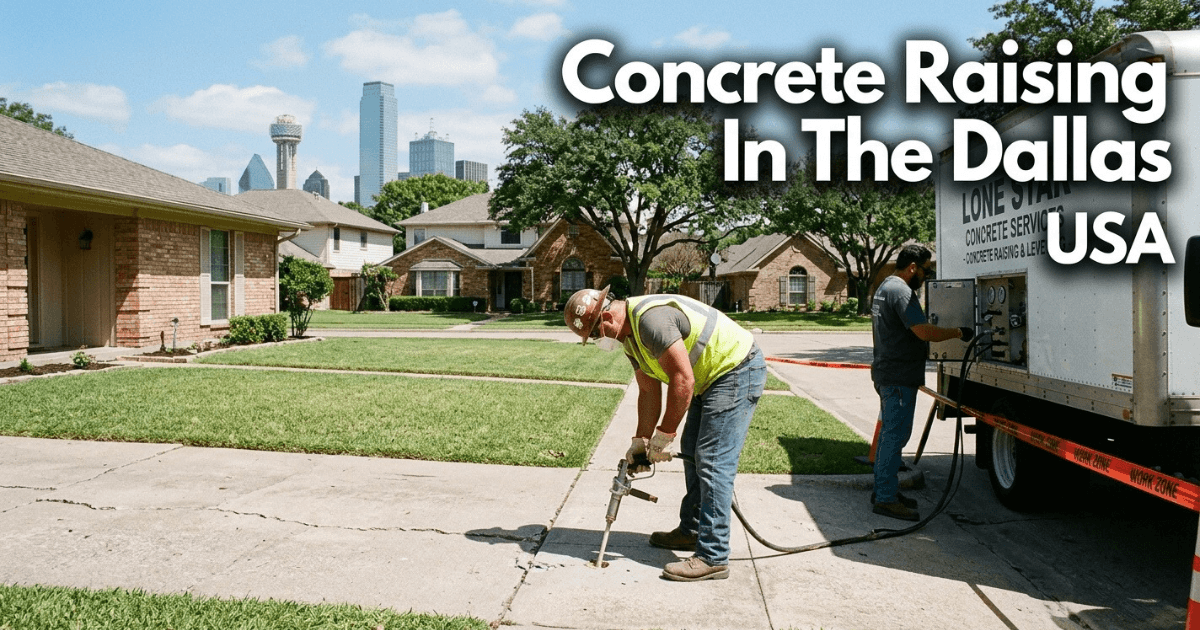
Sunken sidewalks, tilted patios, and driveways that hold water show up across North Texas. Concrete raising in the Dallas lifts those slabs back into place, and concrete leveling evens them out so people can walk and park safely. This guide explains each method, the local providers, and how to choose one.
What is concrete raising, and how does it differ from concrete leveling?
Concrete raising in the Dallas lifts a sunken slab by filling the empty space beneath it, while concrete leveling brings an uneven surface back to one flat, consistent plane. Contractors often use the two terms together because one job usually achieves both. Concrete lifting, concrete slab lifting, and concrete floor raising all describe the same basic goal.
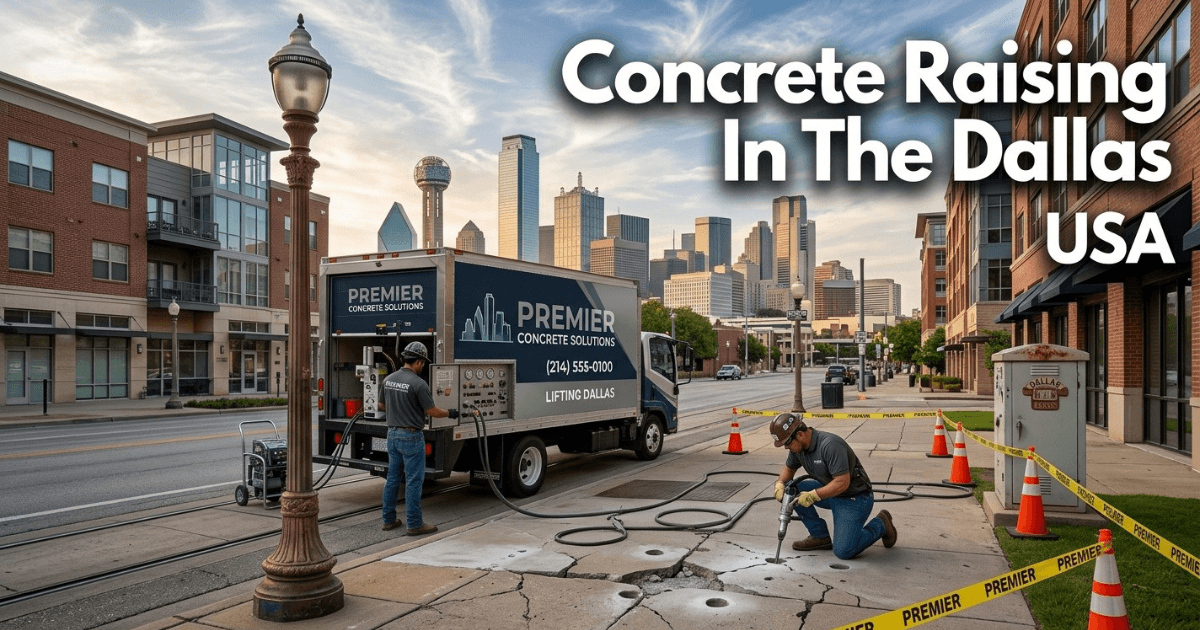
Every concrete slab rests on underlying soil that carries cars, furniture, and foot traffic. When soil washes out or shrinks, voids beneath slabs form and the concrete drops into the gap. A raising crew fills those voids and pushes the slab back up to match its neighbors.
How does polyurethane foam injection work?
Polyurethane foam injection starts with holes about 5/8 inch wide that the crew drills through the slab. Technicians pump a two-part liquid through those holes, and it expands into rigid polyurethane foam that fills gaps and lifts the concrete. Most foam mixes cure within about 15 minutes.
FoamWorks Pro calls its version foamjection and runs the PolyFoam concrete leveling system with recycled polyurethane foam. Its website also describes deep foamjection, which reaches lower soil layers for soil stabilization projects. Because the material acts as a water-insensitive foam, it allows all-weather application, which matters in a region that gets heavy rain.
Polyurethane allows concrete slab lifting without excavation, so your lawn and landscaping stay intact. With no excavation and minimal downtime, you get an immediate return to service and can usually drive on a lifted driveway the same day. In my experience, homeowners value the low-mess work as much as the lift.
Is foam or mudjacking better for sunken concrete?
Mudjacking pumps a cement-based slurry under the slab, while foam relies on lightweight polyurethane. The foam vs. mudjacking debate usually comes down to hole size, weight, and cure time, and foam tends to win on all three. Mudjacking holes often measure 1 to 2 inches across, and the slurry needs longer to harden.
Heavy slurry loads soil that already failed once, which can trigger more settling. Foam adds very little weight yet still offers strong load-bearing capacity for driveways and garage slabs. Mudjacking sometimes costs less up front, so ask each contractor which method it uses and why.
Why do concrete slabs sink in the Dallas–Fort Worth area?
Most DFW slab problems start with expansive clay soil. The Blackland Prairie clay under Dallas, Plano, and much of Collin County swells when wet and shrinks during drought, and that cycle leaves weak soils and unstable soils under the concrete. Poor drainage and erosion speed up the damage.
Intense summer heat dries the clay and opens gaps, and then severe North Texas storms wash fine soil out from under slab edges. Rapid temperature swings add thermal expansion and contraction to the slab itself, which widens joints and lets more water in. Over a few seasons, that pattern produces settled concrete, uneven concrete, and cracked concrete.
Standing water and pounding near your slab tell you the drainage issues have already started. Water that seeps through joints also points to concrete leaks that feed the void underneath. Fixing the slab without fixing the water source only buys you time.
What problems can concrete raising fix?
Concrete raising in the Dallas fixes sunken slabs, raised concrete sections, trip hazards, gaps between slabs, and the voids that cause them. It works best when the concrete stays intact and only the soil shifted. It also corrects slopes that send rainwater toward a house instead of away from it.
Trip hazards create a real safety liability for homeowners, landlords, and business owners. A half-inch lip on a sidewalk can catch a shoe, and property owners often carry responsibility for injuries on their walkways. Raising the low side removes the lip and delivers improved safety without tearing anything out.
What residential surfaces can contractors raise?
Homeowners in North Texas most often call for driveway leveling, driveway raising, sidewalk raising, and walkway leveling. Patio raising, pool deck leveling, and garage floor leveling follow close behind. Contractors also lift concrete steps and stoops and handle gazebo slab raising.
Residential crews also take on stairway repair for damaged stairways, porch repair, retaining wall stabilization, and seawall repair on lakefront lots near Lewisville. Interior floor raising and work on basement slabs come up less often here, since most DFW homes sit on slab-on-grade construction. If your home has a slab foundation, look for a provider that lists slab foundation repair or slab-on-grade foundation repair by name.
What commercial and municipal projects use concrete raising?
Commercial concrete leveling covers parking lot repair, warehouse floor leveling, factory floor leveling, and entrance way lifting. Cities and property managers also use it for municipal sidewalk repair and commercial walkway repair. Many of these jobs target ADA compliance, since uneven paths can stop wheelchairs and walkers.
The 2010 ADA Standards allow a vertical change in level of up to 1/4 inch, and they require a bevel for changes between 1/4 and 1/2 inch. Anything taller needs a ramp or a repair, which makes trip hazard repair for ADA compliance a routine request for shopping centers and offices. Raising the low slab often meets the standard faster than grinding or replacing it.
Larger projects include parking structure leveling, parking garage repair, parking structure pillar repair, and street and alleyway concrete repair. Some providers also list golf cart pathway repair, airport runway repair, manhole leak sealing, storm sewer leak sealing, and bulkhead stabilization. These jobs involve industrial concrete, pillar damage, and heavy loads, so experience with large commercial work matters.
Which Dallas–Fort Worth providers offer concrete services?
FoamWorks Pro and JR&R Concrete LLC both handle concrete work in the Dallas area, but they approach it differently. Each brand offers the services listed on its own website, so check those pages before you call. Several roofing companies also appear in local searches, though they focus on roofs.
FoamWorks Pro offers polyurethane concrete raising in the Dallas and lists void fill, drainage correction, concrete leak sealing, water seepage repair, and Flexcrete structural concrete repair. Its site names the wider Dallas–Fort Worth (DFW) region and lists offices in Garland, Royse City, and Ennis. The company also lists sunken concrete repair, settled slab repair, and cement repair for homes and businesses.
JR&R Concrete LLC works out of Lewisville and serves Dallas and nearby cities as a general concrete contractor. Its site lists concrete repair, foundations, footings, poured walls, flatwork, curbs, and asphalt paving, along with concrete pumping, concrete placement, and concrete pouring. It also offers decorative concrete, stamped concrete, stained concrete, colored concrete, epoxy floors, concrete overlays, concrete resurfacing, concrete polishing, concrete coatings, and concrete waterproofing.
Red River Roofing, Thomas Roofing, and Simmons Roofing focus on roof repair and replacement, and none of their sites list concrete leveling. Absolute Roofing and Roof Repair Plano Texas mention concrete tile only as a roofing material, and the second company serves Plano, Richardson, Frisco, McKinney, Allen, Carrollton, and Addison for roofing alone. Ortiz Construction also appears in local results, so check its website for current services.
What should you look for in concrete leveling companies near me?
Look for a provider that names its lifting method, explains why your slab moved, and puts the full scope in writing. It should also serve your city and handle your surface type. When you search for concrete leveling companies near me, filter the results by those points first.
Texas has no statewide license for concrete contractors, so you need to check credentials yourself. Ask for proof of liability insurance, read recent reviews, and confirm the company has handled surfaces like yours. Providers with geotechnical contracting experience or soil stabilization services usually dig deeper into the cause.
What questions should you ask during the free estimate?
Use the free estimate to learn how the contractor diagnoses your problem. Ask what caused the settling, which material the crew will inject, how many holes it will drill, and how it will patch them. A good damage assessment covers drainage, joints, and nearby downspouts as well as the slab.
Request a written estimate that lists each slab, the target lift, and the warranty terms. Ask how the crew handles job-site cleanup and whether it walks through a final inspection with you before leaving. I always ask for photos of the drill points, because they show whether the crew actually checked under the surface.
Also ask about permit requirements and HOA architectural review if you live in a planned community. Many cities require permits for driveway replacement, so call your city’s building inspections office first. Your HOA may also set rules on color and finish if you choose new concrete.
How much does concrete raising cost, and is it worth it?
Concrete raising in the Dallas usually costs less than tearing out and pouring new concrete, though the price depends on slab size, void depth, access, and extras like drainage correction for standing water on concrete. For a slab in decent shape, it offers a cost-effective alternative to replacement. Most providers in the region quote each job individually after an inspection.
Raising makes sense when you want long-lasting results, curb appeal, and steady property value without weeks of construction. Foam Works Pro describes its foam method as an eco-friendly repair compared with traditional methods. Reusing the slab also keeps broken concrete out of landfills.
When should you remove and replace concrete instead of raising it?
You should remove and replace concrete when it has crumbled, split into many pieces, or shows structural issues beyond soil movement. If a slab breaks apart during lifting, raising it only delays the inevitable. Severe heaving from tree roots also calls for removal.
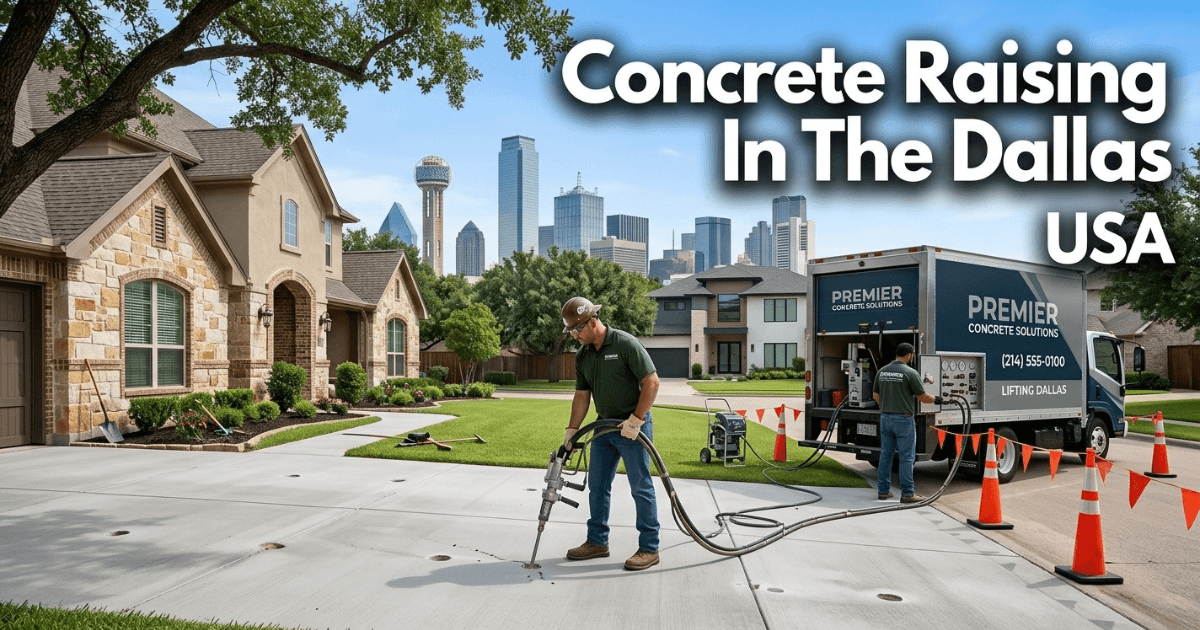
The concrete leveling vs. replacement decision comes down to the slab’s condition, not just its height. Crews can often lift and seal a slab with one or two clean cracks, while a shattered patio needs new concrete. A general contractor like JR&R Concrete LLC, which pours new flatwork, can handle that kind of replacement.
Where can you find concrete raising and leveling in the Dallas Fort Worth area?
Our site gathers local concrete providers in one place and shows the services each one confirms on its own website. Instead of opening ten browser tabs, you can compare methods and service areas, then request quotes. Visit our directory to find concrete raising and leveling in the Dallas Fort Worth area that matches your slab and your city.
What do people often ask about concrete raising in DFW?
How long does concrete raising take?
Most residential jobs take just a few hours, and foam usually cures within about 15 minutes. You can often walk on the slab right away and drive on it the same day. Larger commercial projects may take several days to finish.
Can Foam Lift and Repair a Sinking Driveway and Walkway?
Yes, sunken driveway and sidewalk repair ranks among the most common foam jobs in DFW. Crews drill small holes, inject foam beneath the slab, and lift each panel until it lines up with its neighbors. The method works best when the panels remain mostly intact.
Can concrete raising help my foundation?
Some providers offer foam-based foundation work, but your house needs a careful inspection first, because foundation movement can have several causes. FoamWorks Pro lists settled slab-on-grade foundation repair among its services. Ask any provider to explain how it measures movement before it injects anything.
How do I find concrete leveling companies near me?
Start with providers that confirm concrete raising on their own websites and serve your city. Compare at least two written quotes and ask each company which method it uses. Our directory sorts DFW providers by service and city to speed up that search.
