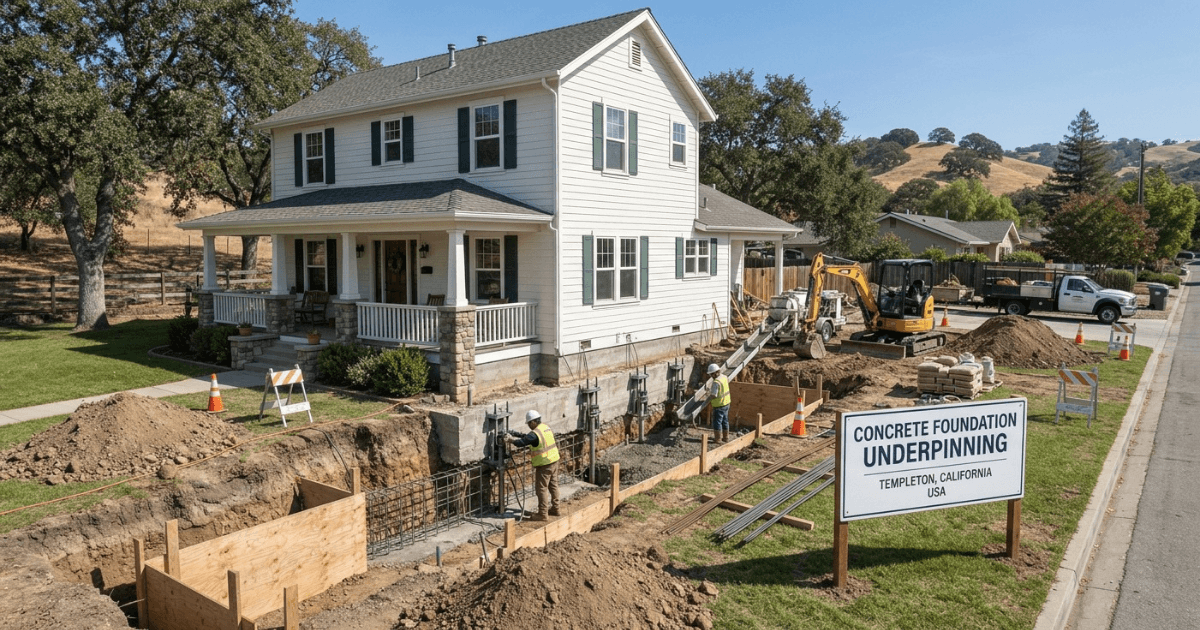
Concrete foundation underpinning strengthens an existing footing by extending it deeper or wider until it rests on load-bearing strata. Contractors carry out this foundation repair when the original base stops holding a house steady. The work also covers deepening existing foundations before an owner adds a second story.
Think of underpinning foundation support as new legs for an old table. Some crews pour concrete beneath the strip foundation, while others drive steel to bedrock. Both aim for load transfer from weak ground to firm material.
Why do Templeton homes need foundation underpinning?
Templeton lies in northern San Luis Obispo County, where many lots rest on expansive clay that swells in winter and shrinks in summer. That cycle of soil shrinkage and moisture changes lifts and drops a slab foundation a little every year. Over decades, the movement adds up.
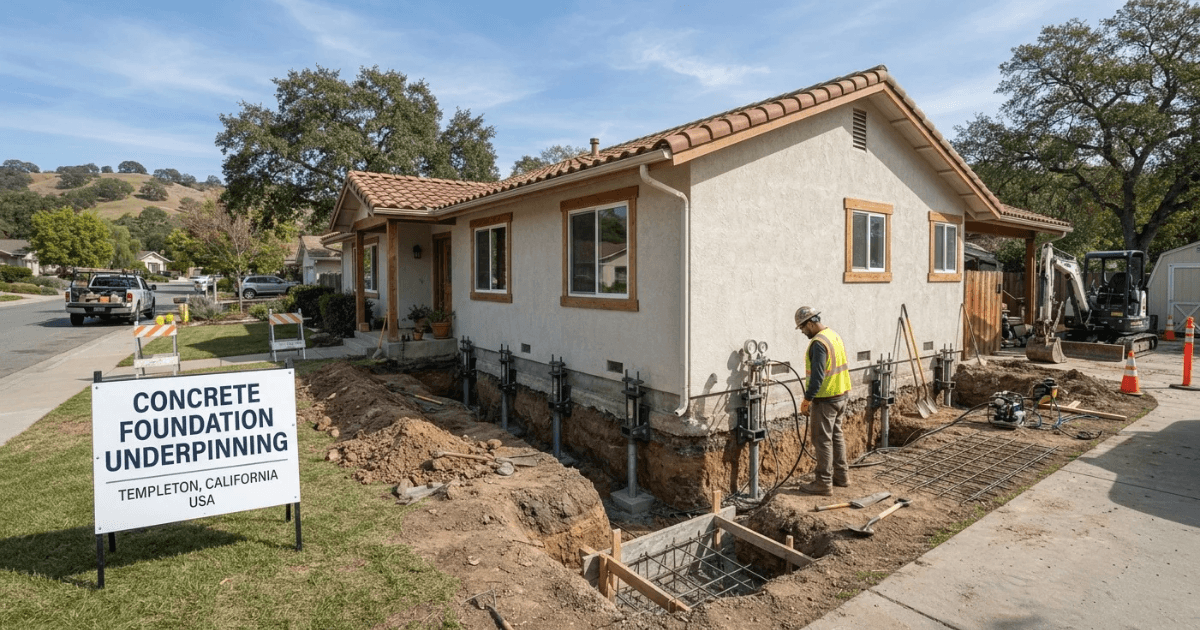
The 2003 San Simeon earthquake badly damaged older masonry in nearby Paso Robles. Erosion, loosely compacted fill, and poor original construction add more stress. A shallow footing on moisture-sensitive soils often needs early foundation stabilization.
What warning signs point to foundation settlement?
Foundation settlement shows up as sloping or uneven floors, sticking doors and windows, and drywall cracks running diagonally from corners. Outside, look for exterior brick cracks and leaning chimneys. One sign may mean little, but several together point to a sinking foundation.
I start every walkthrough by rolling a marble across the floor and closing each door. Gaps around windows and doors and gaps between walls and ceilings show which corner dropped. Sagging floors often mean a pier under a pier-and-beam foundation lost its grip.
Track cracks with a simple crack gauge. Widening cracks over a quarter inch, stem wall cracks, bowed basement walls, and bulging crawl space walls need a professional. Settled concrete slabs, a rocking slab, and pooling water near the foundation also matter.
What causes a foundation to lose support?
Most foundations fail because the soil changes, not because the concrete breaks first. Shifting soil, soil movement, soil consolidation, and subsidence strip away the support a house needs. A high water table in low spots softens clay and speeds the process.
Human choices matter too, including an added structural load, a change of building use, or an adjacent deep excavation. Foundation deterioration, problematic soil layers, voids, and sinkhole conditions weaken the base. The result is a compromised foundation showing structural distress.
Which underpinning methods do contractors use?
Contractors choose from three families: concrete methods, pier and pile systems, and soil treatments. The right pick depends on subsurface conditions, variable ground conditions, site access, and the depth to firm bearing material. A good engineer explains why one option suits your lot best.
How does mass concrete underpinning work?
Mass concrete underpinning follows the pit method: crews dig a box beneath the footing, fill it with concrete, and repeat along the wall. This technique suits cohesive soil that holds its shape. It works best when firm ground sits a few feet down.
Crews use sectional excavation and staggered installation, digging 2 to 4 meter sections in alternating order. Manual hand excavation limits vibration, and temporary support steadies the wall. Each pour needs about 28 days of concrete curing to become a new enlarged foundation.
What are needle beam and beam-and-base methods?
The needle beam method threads needle beams through the foundation wall so jacks carry the building during digging. Some teams reuse temporary steel I-beams, while others cast cantilever RCC needle beams in place. Needle and pile underpinning adds piles at each beam end.
Beam and base underpinning sets a pre-cast concrete beam on mass concrete bases. A pier and beam system spreads weight with horizontal load-distributing beams. Crews seal gaps with cement mortar and rely on reinforced concrete (RCC) for strength.
How do piers and piles compare?
Push piers, which some crews call resistance piers, use house weight and hydraulic force to drive steel to load-bearing strata. Helical piers, or helical piles, twist into soil with helix plates along steel shafts. Both connect through pile brackets and lift the home with hydraulic jacks.
Driven steel piles and concrete piers offer other paths to depth. Corrosion-resistant steel piles with thermoplastic powder coating resist rust in damp clay. Installers prove capacity with torque measurements and load testing.
Micropiles, including hollow bar micropiles and launched SuperMicropiles, handle tight sites and deep foundations. Mini-piled underpinning covers pile and beam layouts, a piled raft, and cantilever pile-caps, with pile-caps joining piles. The micropiling method needs a micropiling rig or limited-access drill rigs.
When do grouting and resin injection make sense?
Grouting and resin methods treat the soil without major digging, so they cause less disruption. Compaction grouting densifies loose ground, permeation grouting fills pore spaces, and void filling plugs empty pockets. Crews mix grout in a grout plant and pump it under pressure.
Resin injection pushes expanding resin, a resin and hardener mixture, into soil to firm it and lift slabs. This minimally invasive underpinning pairs with polyurethane foam jacking, slab jacking, which many call mudjacking, and concrete slab lifting. Together they deliver ground improvement and soil stabilization.
Which foundation types can contractors underpin?
Nearly every type qualifies, including a slab foundation, a pier-and-beam foundation, a raised foundation, a crawl space, and a full basement. Stem walls under raised homes respond well to piers. The method varies, but foundation strengthening stays the goal.
Basements remain uncommon in Templeton, so most local jobs involve slabs and crawl spaces. Many repairs finish with house leveling and structural reinforcement.
How does the underpinning process work step by step?
A sound job moves from property inspection to design, installation, and final checks. The engineer starts with a structural engineering assessment and a diagnosis of movement cause. Skipping either step treats symptoms instead of causes.
Next comes determining pile number and depth and pre-excavation to confirm foundation depth. Crews add a temporary foundation where needed and shift weight to the new supports. They finish by backfilling, raising settled slabs, and rechecking load capacity.
What safety and engineering checks matter?
Underpinning removes support from a loaded wall, so it demands a qualified structural engineer and proper permit documentation. In unincorporated Templeton, the San Luis Obispo County Planning and Building Department issues building permits.
Careless digging can cause an excavation collapse, and piling rigs can cause vibration damage. A vibration sensitivity check protects fragile finishes. Engineers calculate compression and tension forces, confirm bearing capacity, and prevent loss of bearing capacity in the cone of soil.
Which brands offer underpinning services?
Each brand below offers the services listed on its own website, so read those pages directly. Coverage changes, so confirm each serves San Luis Obispo County. Foundation Solutions lists foundation underpinning, wall anchors, crawl space supports, push piers, polyurethane foam jacking, and helical piers.
Foundation Solutions also lists a wall repair system and retaining wall stabilization for homes and businesses. It states that it is not an engineering firm and hires a licensed engineer when needed. Geo Stabilization International describes underpinning for infrastructure, commercial, and industrial projects.
Geo Stabilization also lists repair of compromised foundations, raising settled slabs, sinkhole stabilization, load capacity upgrades, ground improvement, and micro piles. Helicon lists foundation repair, soil stabilization, sinkhole repair, helical piers, permeation grouting, and compaction grouting for homes. Its commercial list adds helical piles, push piers, micro piles, and void filling.
Intech Anchoring offers helical underpinning, resistance piers, hollow bar micropiles, helical piles, and wall anchors. It also rents and sells load testing equipment and grout plants. Understand Construction offers no services, but its educational pages explain the pit method and needle beam method.
What Sets a Great Service Provider Apart?
Look for a licensed California contractor, a written engineering plan, clear warranty terms, and references from nearby jobs. Plain explanations usually signal an honest provider.
Ask each company which method it recommends and why it ruled out others. Request the planned pile depth, expected load capacity, and copies of load testing or torque measurements. Vague answers signal a sales pitch, not a plan.
This site gathers Templeton-area providers in one place, so you can compare services and coverage side by side. Then open each company’s pages to confirm details. That saves time and keeps the final choice yours.
How much does concrete foundation underpinning cost?
Cost depends on the method, the number of piers or pits, soil depth, and site access. A few piers under one corner cost far less than full-perimeter work. Compare at least three itemized written quotes line by line.
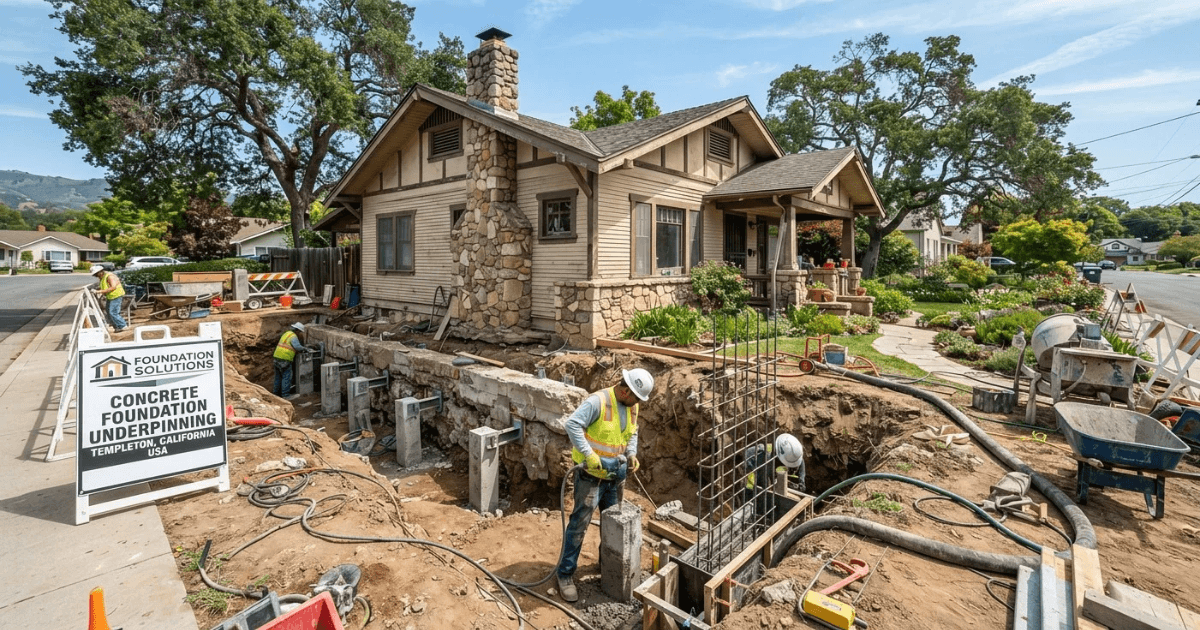
Watch for extras like engineering fees, permits, landscaping, and interior patching. Pier systems often carry transferable warranties, while concrete methods rely on workmanship. I always ask how a contractor prices extra depth, because local clay often hides firm soil deeper down.
Is concrete foundation underpinning worth it?
For most homeowners with active settlement, yes, because underpinning fixes the cause instead of patching cracks. It protects resale value, keeps doors and plumbing working, and stops damage from spreading. Waiting usually makes the repair larger, since a moving foundation rarely stops on its own.
Minor movement that stays stable over a year may only need drainage fixes. Gutter extensions and regraded soil often solve those cases first. A qualified structural engineer can tell you which camp your house falls into.
Where can you find concrete foundation underpinning in Templeton, CA?
You now know the warning signs, the main methods, and the questions that separate a careful contractor from a quick sale. Next, compare providers who serve your area. Visit our concrete foundation underpinning Templeton, CA page to compare local options and choose with confidence.
What do Templeton homeowners ask about underpinning?
Templeton homeowners usually ask about timelines, daily disruption, and insurance before they commit to underpinning. The short answers below cover each concern in plain terms. Your own engineer and contractor can add details that fit your specific house, soil, and lot.
How long does underpinning take?
Most pier jobs on a single-family home take a few days, while mass concrete underpinning can stretch over several weeks because of curing. Weather, permits, and access also shape the schedule. Ask for a written timeline before work begins.
Can I stay home during the work?
Most families stay home during pier and grouting work, since crews work outside or in the crawl space. Slab jobs may require some interior access. Expect noise, dust, and torn-up landscaping.
Does homeowners insurance cover underpinning?
Standard policies usually exclude settlement and earth movement, so most owners pay out of pocket. Earthquake coverage may help if a quake caused the damage. Call your agent to confirm your coverage.
