
The right height, the right wind quality, and the right expectations decide everything from day one. This article walks through what a homeowner needs to know before installing a home wind turbine, written the way I would explain it to a neighbor standing in his own backyard.
Types of Home Wind Turbine
A home wind turbine usually comes in two designs, and picking between them depends more on your site wind quality than on any catalog claims printed on a brochure. A Horizontal Axis or HAWT turbine works best on open plots where a tower or pole can be raised properly.
It is commonly chosen for farmhouses and independent properties because it captures clean steady airflow once lifted to the right height. A Vertical Axis or VAWT machine suits places where wind direction shifts often or space constraints limit a full standalone tower.
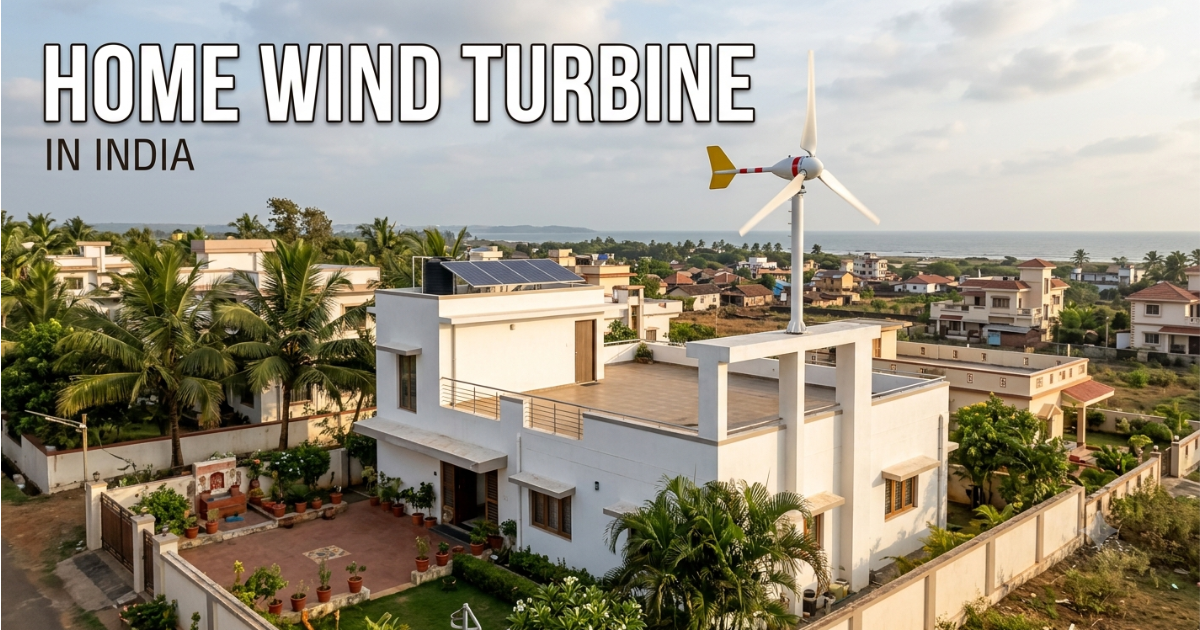
Home Wind Turbine can perform well in specific layouts, but its output still depends on airflow quality. If you install this type of turbine on a rooftop, you need proper structural checks and vibration checks first.
Beyond the axis type, the second choice is where you place it on the property. Roof-mounted wind turbines are cheaper to install and can typically generate around 1 to 2 kilowatts, which suits small loads.
System Sizing
Anyone browsing Amazon or Home Depot style listings will find small turbines priced anywhere from $150 to $6,000. It is tempting to assume these will meaningfully cut your bill, but the numbers rarely hold up in real conditions.
Under a steady 12 mile per hour wind, most of these units generate only a few hundred kilowatt hours per month. That figure often comes from optimistic forecasts built on optimal conditions, ignoring real energy lost in transmission.
It also skips the cost of a tall tower needed to reach cleaner air, which adds real expenses. Because of this gap, smaller machines usually work best as a supplement to solar rather than a full replacement.
A typical buyer for these smaller units lives in a rural location, is often a rancher or farmer. He needs power in a remote part of the property, and even an off grid home may get only around 1 percent from wind.
Why a 5 kW Wind Turbine Wins Over Homeowners
A 5 kW home wind turbine earns its place when a family wants wind to matter for priority usage, not just sit in the background. It supports faster battery charging during windy hours and fits neatly into hybrid setups or off-grid setups.
This size comfortably powers more rooms, fans, lights, and electronics than a smaller unit ever could. In practical terms, it gives quicker battery recovery, smoother storage replenishment, and easier load planning.
A household can run its essentials together instead of switching appliances on and off all day. Many families in India pair wind with solar combinations, since wind often carries daytime strength into evenings.
During monsoon or other windy periods — always site-dependent — the two sources balance each other nicely. This setup suits larger properties best, including farmhouses, corner plots, and open sites, where clean airflow at height is achievable.
It is also an upgrade-friendly system, leaving room for more monitoring or additional renewable capacity later. There is no need for redesigning the tower or pole when you plan this kind of system with future growth in mind.
One honest caution from experience: if the air near your site is turbulent wind because of nearby roofs, trees, or buildings, expect trouble. A real performance drop happens even with a higher-rated machine, so site quality always comes first.
Home Appliances Supported by a 5kW Wind Turbine
A properly sized 5kW wind turbine can comfortably run priority appliances while keeping up steady battery charging through windy hours. This works provided the inverter and batteries are matched correctly for backup.
In most homes, this covers Lights, fans, Wi-Fi, router, and CCTV, along with charging points, without any strain. It generally stretches to a TV and other daily electronics as well.
A Pump or washing machine is also possible, but only with a surge-capable inverter and correct sizing from the start.
Running a 1 inverter AC, close to 1 ton, is realistic only inside a full hybrid setup with enough battery headroom. Treating it as wind-only with no inverter headroom to spare is where most people go wrong.
Estimating the Real Energy Output of a 5kW Turbine
I always remind clients that the rated number on a brochure is not a constant output. Real generation depends entirely on wind quality at height, the level of turbulence, and how well the system matching was done.
The average wind speed at turbine height decides everything for any residential wind installation. At 3–4 m/s, expect roughly 3–9 kWh/day; at 5–6 m/s, this climbs to about 9–22 kWh/day.
Once you reach 7+ m/s, output can rise to 18–45 kWh/day, which is a strong result for most homes. These numbers work only for early planning, so a proper site evaluation with a practical mounting plan is the safest approach.
Why Choose Synergy Automatics for a 5kW Home Wind Turbine Project
Every good installation runs on on-time installation and disciplined execution from start to finish. We follow a clear project plan with fixed milestones, so fabrication, dispatch, and setup move on a controlled timeline.
We rely on quality materials and a reliable build for every home wind turbine we deliver. This means choosing sturdy mounting structures, corrosion-resistant hardware, and dependable electrical components for long-term performance and safer operation.
Our Pan-India project support covers supply and full coordination for commissioning across states. This does not stop at handover — after-installation service and maintenance continue with regular inspections.
Quick troubleshooting assistance, ongoing performance checks, and honest spares guidance follow every project we complete. The professional finishing stage includes proper cabling, careful earthing, surge protection, and lightning protection.
Where Residential Wind Power Could Make Sense
Not every plot suits a turbine, and I say this honestly to every homeowner who asks about a home wind turbine. The site needs to be genuinely windy, ideally rural, and paired with huge electricity bills big enough to justify the investment.
As a working rule, you want an average wind speed above 10 or 11 miles per hour, or roughly 4.5 to 5 meters per second. Agencies like the National Oceanic and Atmospheric Administration, known as NOAA, publish wind maps that help with early checks.
How Much Does It Cost to Install a Small Wind Turbine?
The all-in price of any home wind turbine depends on location, the product chosen, and the installer. It also includes permitting, tower construction, connection to the electric grid, and sometimes batteries too.
One widely used figure from the American Wind Energy Association places costs between $3,000 and $5,000 per kilowatt. This means a smaller five kilowatt setup could cost around $15,000, while a larger 15 kilowatt system could reach $75,000.
Individual states sometimes offer their own support on top of federal schemes for renewable projects. Whether the whole project stays cost-effective depends on your wind resource and usage, plus ongoing maintenance costs and labor.
Top Wind Turbine Manufacturers in India
India’s turbine market includes several established names worth knowing before you choose a manufacturer for Home Wind Turbine. Global names like Siemens, Suzlon, and Winds of the World operate here alongside homegrown players from India itself.
These include Regen Powertech private limited, Inox Wind limited, Orient Green Power Limited, Indo wind Energy Limited, and RRB Energy Limited. Alongside these sit major international players such as Vestas India and Enercon India Pvt limited.
Gamesa wind turbines private limited and GE Wind Energy Limited round out the list of serious options. This gives Indian buyers a genuinely wide field to choose from when planning any project.
How Long Does It Take to Install?
A simple roof mounted Home Wind Turbine can usually be fitted within few hours by a trained professional. Standalone wind turbines naturally take longer because of tower work and foundation needs.
Either way, hiring a trusted professional for the installation is worth it every single time. This matters especially for standalone systems, where mistakes are costly to fix later.
How Do Wind Turbines Work?
The idea is simple once you see it in person: wind turns the propeller-like blades of a home wind turbine. This spins a rotor connected to shafts, and the shafts drive a generator that produces a flow of electrons.
This becomes usable electricity, stored in an external battery bank for later use. Every supplier sets a minimum wind speed requirement, usually around 5.5 mph, below which the blades spin too little to matter.
The rated energy output only appears at the rated wind speed, the point where the generator hits max capacity. For example, a 500W turbine rated for 27 mph will produce barely 100W if actual wind sits at 10-12 mph.
Advantages of Wind Power
Wind stands out as genuine clean energy and renewable energy, with short installation time and zero fuel cost. It also carries low operation cost plus maintenance cost over the life of the system.
It leaves the environment largely untouched, staying pollution free and environment friendly. A home wind turbine also offers space saving benefits on the ground compared to sprawling solar arrays.
It supports domestic economic growth through local jobs and local manufacturing across India.
Challenges of Wind Power
No system is perfect, and even well-planned wind setup faces real limits. Wind must compete against other low-cost energy sources, which creates real competition in pricing.
Turbines also generate noise and change visual aesthetics of a property, which not everyone likes. They can pose danger to wildlife, particularly birds, in certain locations.
Performance always faces a location limitation, since not every plot has usable wind for this kind of system.
Conclusion
It also helps to study prevailing wind directions before committing to any home wind turbine design. Beyond geological formations, watch for real obstacles like trees, houses, and sheds nearby. Plan for future obstructions too, including new buildings that have not yet reached full height.
Always aim for upwind sitting away from these obstacles for the cleanest possible airflow. On the system side, stick to equipment tested against recognized national performance standards and safety standards.
FAQs
Is a home wind turbine actually worth it for an Indian household?
It is worth it only when the site is genuinely windy, ideally rural, and the electricity usage is high enough to justify the setup cost.
How much does a 5kW residential wind turbine cost to install in India?
Costs vary by location, installer, and components, but a properly installed 5kW system typically falls in the mid-range once tower construction, batteries, and inverter setup are included.
Can this kind of turbine work along with solar panels?
Yes, many Indian households’ pair winds with solar, since wind often generates more during evenings and monsoon periods when sunlight is low.
What is the minimum wind speed needed for a small wind turbine to work?
Most systems need an average wind speed of around 5.5 mph to start spinning, though the rated output only appears at the turbine’s rated wind speed.
Which is better, a 3 blade or 5 blades home wind turbine?
A five blade design generally improves annual performance and lowers the risk of high-speed malfunction compared to a traditional three-blade turbine.
